
Fearless Persistence

launches in

0

days

Pre-order now
Why strategies fail

Most organizations don't have a strategy problem. They have a transmission problem.

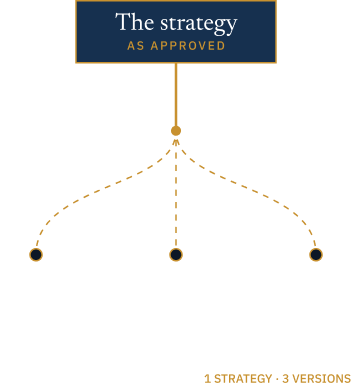
Your board approved it. Your leadership team said, “Let’s go!” Six months later, finance is measuring one thing, operations is building something else, and the people at customer-level are wondering if this one sticks. Same strategy. Three versions. And you may be the last to know.
Request an executive conversation
take the executive self-test (5 minutes)
10 questions for CEOs, board members, leadership teams
the transmission problem
STRATEGY
Sound
LEADERSHIP TEAM
Capable
RESOURCES
In place

And yet, results still fall short.

Priorities compete. Teams interpret the same message differently. Transformation loses momentum when leadership and the people who need to make it happen are disconnected.Several months before the leadership session, and again approximately thirty days before it, conversations with senior leaders began to reveal a common pattern.In conversations with senior executives before the leadership session, the underlying problem began to come into focus.

These failures are common, and they're usually blamed on execution, resistance, or accountability.

Let's look at the system instead. Strategy creates value only when the organization understands it, accepts it, and acts.

Adam Leipzig advises executive teams on where that transmission breaks and what must change to restore alignment, adoption, and results.

Five ways strategy breaks down

These five failures show up again and again.

Which, if any, resonate with you?
The failure
Where you'll see it
Executive question
01
The signal weakens
Leadership communicates a clear direction, but the message loses force as it moves through layers of management. What began as a compelling priority becomes a vague objective.
A priority that was one sentence at leadership level becomes a paragraph at the VP level and, at best, a vague slogan on the floor.
Is your original intent reaching the people responsible for delivering it?
02
Priorities compete
Business units, functions, and leaders pursue conflicting objectives. Resources and attention fragment, even when everyone thinks they're supporting the strategy.
Each leader is still delivering against their old targets. Nothing was canceled to make room for the new plan, so it just added to the overwhelming workload.
Are all leaders reinforcing the same priorities, or unintentionally working against one another?
03
Meaning changes
Different audiences interpret the same message differently. Leadership assumes everyone is aligned because they heard it at the all-hands meeting and saw the CEO's video. But employees, managers, investors, and customers take away different meanings.
The CFO heard cost reduction. The CIO heard platform consolidation. Operations heard job risk. But that's not what the CEO tried to communicate.
Does the full organization share the same understanding of what success requires?
04
Adoption stalls
People may understand the strategy without accepting it, trusting it, or changing their behavior. They give reports, but that isn't progress.
People eye-locked and agreed. Eight weeks later, the stand-ups are exactly what they were.
What prevents understanding from becoming commitment and action?
05
Communication fragments
Messages, decisions, incentives, and leadership behaviors send inconsistent signals. Meetings, presentations, internal channels, and operating processes all have different versions of the strategy.
The town hall takeaway was one thing; the incentive plan another; the investor deck something else.
Does the organization's communication system reinforce one direction, or create competing interpretations?
Recognize two or more? Take the Executive Self-Test, or request an executive conversation.

executive self-test • confidential

Is your strategy reaching the people who have to act on it, so they do act on it?

Ten questions, about five minutes. Choose the one strategy you most need to operationalize, and give your best answer as of today.
choose the closest answer
Verified
I have tested this directly with the people involved in the last 90 days.
Likely
I believe it is true, but I have not checked.
Mixed
It is true in some parts of the organization and not others.
No
No, or I don't know.
01 · The signal weakens

Has the signal weakened?

q01
If you asked three leaders to state the strategy's top three priorities in their own words, their answers would match yours.
Verified
3 pts
Likely
2 pts
Mixed
1 pts
No / don’t know
0 pts
q02
A decision the executive team made this quarter is being carried out as intended by those responsible.
Verified
3 pts
Likely
2 pts
Mixed
1 pts
No / don’t know
0 pts
02 · Priorities compete

Do priorities compete?

q03
Every member of the executive team would name the same priority as the winner when two of their objectives conflict.
Verified
3 pts
Likely
2 pts
Mixed
1 pts
No / don’t know
0 pts
q04
Something has been stopped, defunded, or deprioritized to make room for our current strategy.
Verified
3 pts
Likely
2 pts
Mixed
1 pts
No / don’t know
0 pts
03 · Meaning changes

Did the meaning change?

q05
Finance, operations, sales, and technology can each define success for your strategy on the same terms.
Verified
3 pts
Likely
2 pts
Mixed
1 pts
No / don’t know
0 pts
q06
Your board, your largest investors, and your senior leaders can explain the logic of the strategy in the same way.
Verified
3 pts
Likely
2 pts
Mixed
1 pts
No / don’t know
0 pts
04 · Adoption stalls

Has adoption stalled?

q07
You can name specific behaviors at the operations level that have changed since the strategy was announced.
Verified
3 pts
Likely
2 pts
Mixed
1 pts
No / don’t know
0 pts
q08
The people who must change the most have told you directly how they believe this strategy requires reallocations or adjustments, and you have acted on what you heard.
Verified
3 pts
Likely
2 pts
Mixed
1 pts
No / don’t know
0 pts
05 · Communication fragments

Did communication fragment?

q09
Budgets, incentives, and performance measures are aligned to reward the behaviors the strategy requires.
Verified
3 pts
Likely
2 pts
Mixed
1 pts
No / don’t know
0 pts
q10
The story you tell inside the company and the story you tell investors, customers, and regulators are the same story.
Verified
3 pts
Likely
2 pts
Mixed
1 pts
No / don’t know
0 pts
2 out of 10 answered
the governing principle

Quality x Acceptance = Effectiveness

The quality of an idea alone does not determine its impact. Its effectiveness depends on whether the people who matter understand, trust, and accept it enough to act.

This formula is multiplicative, not additive. As an illustration, a strategy that is 90 percent on-point but 50 percent accepted performs at 45 percent. A strategy with no acceptance performs at zero, no matter how brilliant it is.

Communication is not a packaging layer around a strategy. It is a genuine, measurable operating system that moves a strategy through an organization. And acceptance is largely a function of trust: people act if they believe leaders understand their reality.

Most organizations invest heavily in quality: the analysis, the plan, the roadmap. Far fewer examine acceptance, even though acceptance is the true force-multiplier. As AI changes the workplace faster than organizations can absorb it, the distance between a decision and its understanding is only widening.

why adam

Adam Leipzig built his career where intent had to survive thousands of people and hundreds of decisions.

As a senior executive at Walt Disney Studios and president of National Geographic Films, he was responsible for both the cost of creative work and its earnings

Disney · National Geographic

Leadership in developing and distributing enterprises to global audiences.

10,000+

Senior executives and creative artists, especially in enterprise and technology environments, helping senior leaders examine how ideas are communicated, understood, and put into practice.

UC Berkeley Haas

Professional faculty at UC Berkeley's Haas School of Business and Berkeley Executive Education. Teaching and developing executives and students in communication, strategy, and storytelling.

$2B+

In revenue on $300 million invested, including twice the most profitable picture of the year. Experience in complex, high-stakes creative and commercial environments.

40+

Films that have won or been nominated for 10 Academy Awards.

Today Adam advises leadership teams in technology, financial services, defense, and government. He found the same pattern in every setting: the strategy was rarely the problem.

Full background