When every audience requires a different signal.
Large international financing entity with relationships across sovereign governments, regulatory bodies, and portfolio companies in multiple sectors.
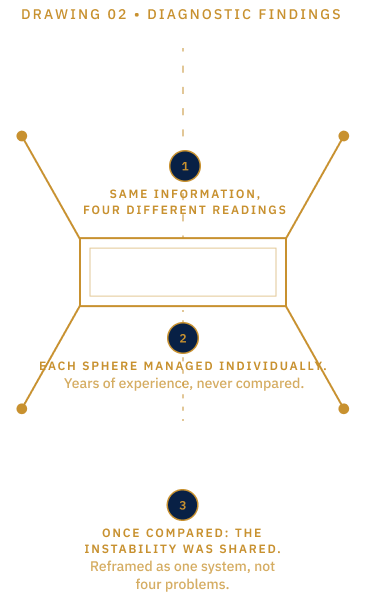
Excellent information, and 4 audiences who each heard something else.
Senior leaders operated in an unusually complex network of relationships: sovereign governments, ministries, regulators, investors, portfolio company boards, and executives across multiple jurisdictions and sectors.
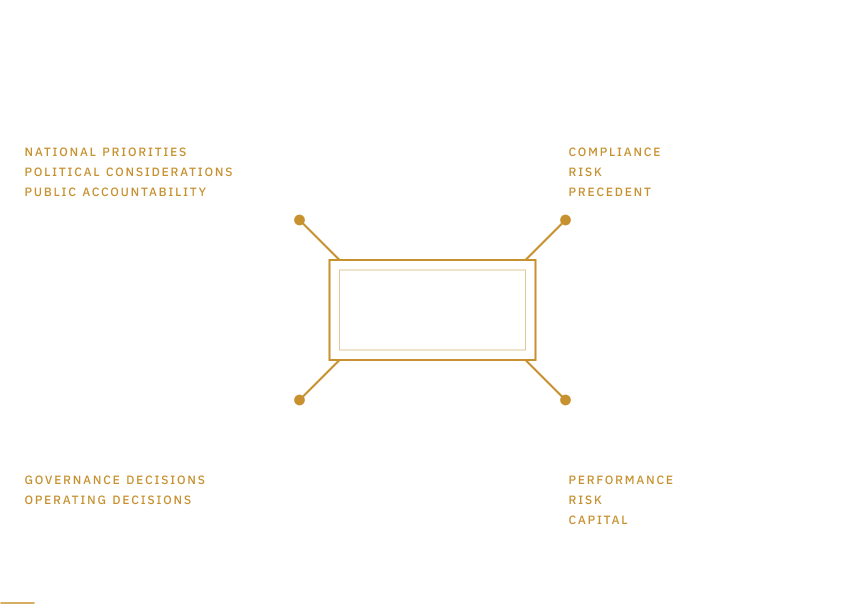
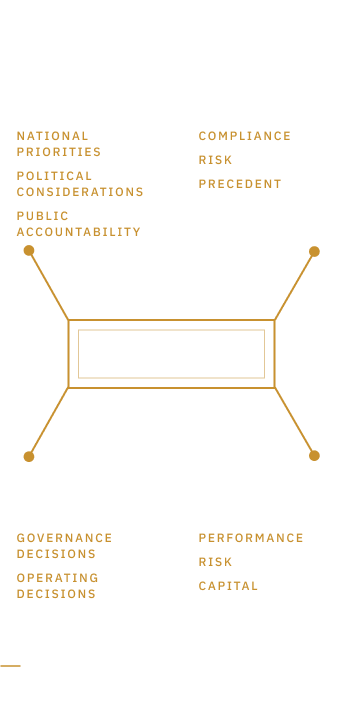
Each set of stakeholders required different information, shared uniquely, and held different expectations. A government ministry might be focused on national priorities, political considerations, and public accountability. A regulator might be concerned with compliance, risk, and precedent. A portfolio company board needed information that could support governance and operating decisions. Investment stakeholders had their own expectations about performance, risk, and capital. The same information could produce very different responses depending on who received it and how it was presented.
External volatility made it harder. Leadership changed, sector conditions shifted quickly, and energy markets could be affected almost overnight by instability around the Strait of Hormuz. Leadership was managing highly consequential relationships without a common approach for deciding how information should be framed, carried, and acted upon.
Senior leadership increasingly felt that they were operating under continuous scrutiny, particularly from the institutions and stakeholders connected to the fund's capital. They were managing highly consequential relationships without a common approach for deciding how information should be framed, carried, and acted upon. The organization had excellent information. The difficulty was getting that information to land consistently with very different audiences.
Everyone was solving it alone.
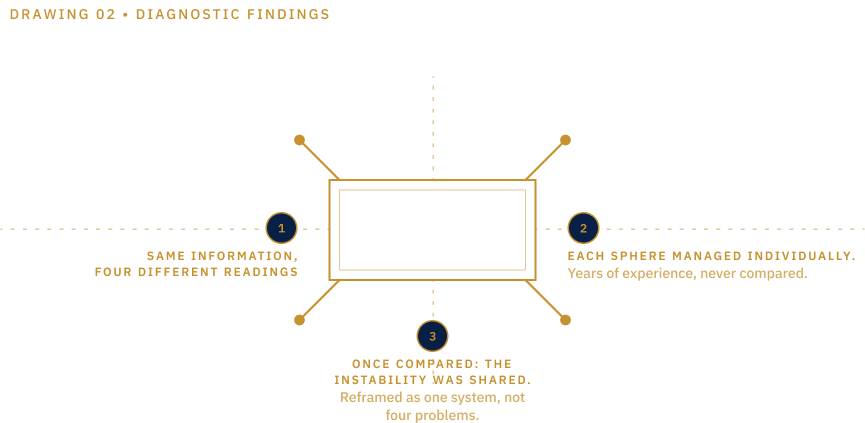
Several months before the leadership session, and again approximately thirty days before it, conversations with senior leaders began to reveal a common pattern.In conversations with senior executives before the leadership session, the underlying problem began to come into focus.
People across the organization were encountering different versions of the same problem. Information that seemed compelling in one setting could fail in another because the audience was working from a different set of priorities, incentives, risks, or expectations.
There was another important discovery. The senior leaders and board members had largely been dealing with these challenges individually. Each person had developed ways of handling the stakeholders in their own sphere, but the group had never examined these experiences together.During the session, approximately twenty-five senior leaders examined specific points where information and intent had failed to move through the organization. As they worked through actual examples, a larger pattern became visible.
Once the conversations were compared, it became clear that the instability people were experiencing was shared. So were many of the underlying causes. That made it possible to approach the issue as an organizational system rather than as a collection of individual communication problems.
THE CENTRAL FINDING
The organization had excellent information. The difficulty was getting it to land.
Four teams, four stakeholder environments.
C-suite and board leadership gathered to examine these experiences together for the first time. One of the most important moments came early: people who had worked together for years began describing situations they had been managing largely on their own. As the stories accumulated, the similarities became unmistakable. There was relief in recognizing that these were shared organizational challenges. More importantly, there was now something the group could work on together.The leadership team mapped the path the strategy had to travel, from the C-suite through management, operating teams, and key external partners.
The leaders then divided into teams based on the stakeholder environments they knew best: government ministries, regulators, portfolio companies, and investment stakeholders. Each team worked through actual communication situations and identified what made information credible and actionable for that audience. They also examined the conditions that could cause an otherwise strong message to fail.They examined how the message needed to change as it moved from one audience to another. They identified places where authority had become unclear, where accountability was diffuse, and where people were being asked to execute without enough context to make good decisions.
THE GOVERNING PRINCIPLE
A consistent principle ran through the work. Strong information only creates value when the audience can
Receive it


Trust it
Act on it
The group built an architecture for bringing these practices to the teams below senior leadership so that the discipline developed during the session would become part of how the organization operated, rather than remaining dependent upon the instincts and experience of a small number of senior people.
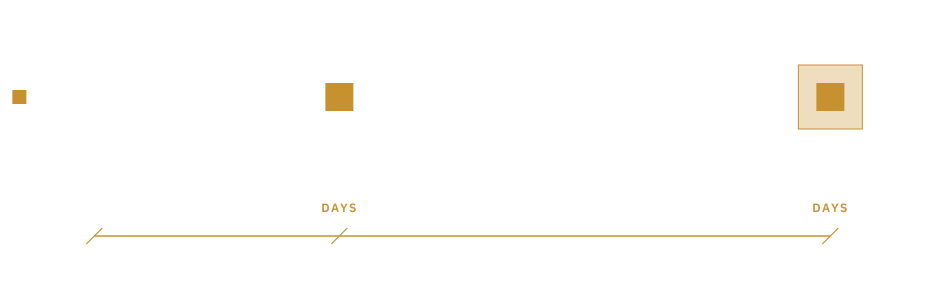
Thirty days to results, ninety days to institutional.
Within thirty days, the organization reported results in both government ministry relationships and portfolio company engagements. Leaders were applying the approaches developed during the session and seeing stronger responses.
At ninety days, the transfer process had moved further into the organization. Teams below the senior leadership level had begun using the frameworks in their own stakeholder relationships and adapting them to the situations they encountered.
The capability was becoming institutional rather than remaining concentrated at the top.
WHAT THIS ENGAGEMENT ADDRESSED

Request an Executive Conversation
A 45-minute call to look at one strategy you're currently trying to land, and where it's most likely getting lost.